
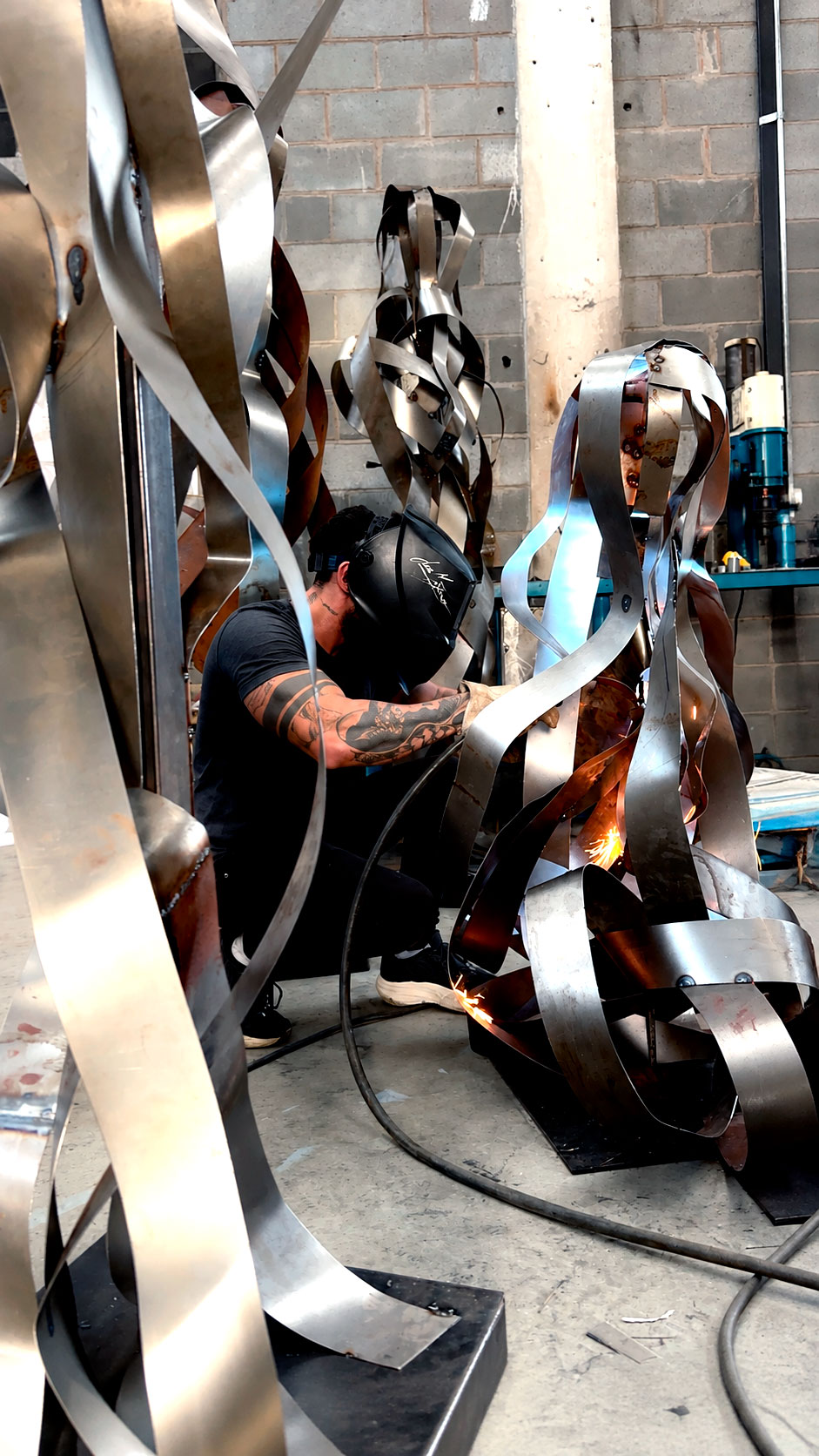
Contemporary Steel Sculpture: Matter, Gesture and Transformation
Steel usually enters the studio as an industrial material: flat, rigid, heavy and seemingly distant from the human body. In the sculptural process of Brazilian artist Juca Máximo, that material is bent, tensioned, cut and welded until it begins to move.
It is through this confrontation between resistance and gesture that the sculptures emerge.
The process is not simply about representing a figure. It begins with the attempt to make a structurally rigid material carry qualities that seem almost incompatible with it: lightness, tension, movement and human presence.
From Flat Steel to the Human Body
The sculptures are constructed from strips and fragments of steel that gradually stop behaving like surfaces and begin to draw volumes in space.
Each piece of metal becomes a line. As those lines approach, cross and separate from one another, they begin to suggest anatomy, posture and movement without requiring the body to become a completely closed volume.
Empty space is therefore part of the sculpture.
Rather than concealing its construction, the work reveals it. Welds, tension, curves and connections between the steel strips remain visible as part of the visual language. The result approaches a form of three-dimensional drawing.
Sculpting Means Negotiating With Matter
Unlike a drawing that can be extensively resolved before execution, sculpture continuously demands new decisions.
The piece must be observed from the front, from the side and from behind. A curve that appears correct from one angle may lose its strength when the figure is seen from another direction.
The process therefore becomes a constant sequence of actions: cut, bend, position, weld, observe, remove and rebuild.
The final form emerges from this direct negotiation between artistic intention and physical material. Matter responds. The artist responds again.
Gesture Remains Inside the Steel
There is a direct relationship between these sculptures and the drawing language found throughout Juca Máximo’s work. Lines that once existed on paper or canvas now physically occupy space.
But there is an essential difference. In steel, a line has weight. It must remain standing. It must resist gravity. It must encounter another line capable of supporting it.
At that point, gesture stops being purely graphic and becomes structure.
Between Figuration and Abstraction
Although the presence of the human body can often be recognized, these sculptures do not seek literal anatomical representation.
The figure emerges through fragments. One curve may suggest a shoulder. Another may create the impression of a waist. Two strips of steel may be enough to indicate the movement of a leg. The viewer completes what is missing.
This territory between figuration and abstraction allows the sculpture to remain simultaneously body and gesture.
À Flor do Aço
This investigation into steel, body and transformation reaches a new scale in À Flor do Aço, Juca Máximo’s project for CASACOR Ceará 2026.
The project explores steel precisely through its capacity to inhabit apparently contradictory states: strength and delicacy, structure and movement, permanence and transformation.
Figurative sculptures, monumental structures and spatial interventions transform an industrial material into artistic language. Steel is therefore more than a medium. The material itself becomes part of the concept.
The Process Becomes Part of the Artwork
Welding marks, heat transformations, tonal variations and subtle irregularities do not necessarily need to disappear from the finished sculpture. They record transformation. The surface reveals what happened to the material.
The sculpture therefore presents more than a finished figure. It preserves traces of the process that brought it into existence.
Perhaps this is why these works are best experienced while moving around them. As the viewer changes position, new lines appear, others disappear and the negative spaces continuously transform.
The sculpture never offers exactly the same image twice. It is within this interval between matter, body, space and time that the work exists.
Escultura em aço contemporânea: matéria, gesto e transformação
O aço normalmente chega ao ateliê como matéria industrial: plano, rígido, pesado e aparentemente distante do corpo humano. No processo artístico de Juca Máximo, essa matéria passa a ser dobrada, tensionada, cortada e soldada até assumir movimento.
É nesse confronto entre resistência e gesto que suas esculturas começam a existir.
O processo não parte apenas da intenção de representar uma figura. Ele nasce da tentativa de fazer com que uma matéria estruturalmente rígida carregue algo que parece incompatível com ela: leveza, tensão, movimento e presença humana.
Da chapa plana ao corpo
As esculturas são construídas a partir de faixas e fragmentos de aço que deixam de funcionar como simples superfície e passam a desenhar volumes no espaço.
Cada tira metálica cria uma linha. Ao se aproximarem, cruzarem e afastarem, essas linhas começam a sugerir anatomia, postura e movimento sem a necessidade de construir um corpo completamente fechado.
O vazio também participa da obra.
Em vez de esconder sua estrutura, a escultura revela o modo como foi construída. Soldas, tensões, curvas e encontros entre as chapas permanecem como parte da linguagem visual. É quase um desenho tridimensional.
Esculpir também é negociar com a matéria
Diferentemente de um desenho previamente resolvido, a construção de uma escultura exige decisões constantes.
A peça precisa ser observada de frente, de perfil e por trás. Uma curva que funciona de determinado ângulo pode perder força quando o corpo é visto de outra direção.
Por isso, o processo envolve uma sequência contínua de construção e revisão: cortar, curvar, posicionar, soldar, observar, retirar, reconstruir.
O resultado nasce dessa negociação direta entre intenção e material. A matéria responde. E o artista responde novamente à matéria.
O gesto permanece no aço
Existe uma relação direta entre essas esculturas e o desenho presente em outras linguagens do trabalho de Juca Máximo. As linhas que antes atravessavam papel e tela passam a ocupar fisicamente o espaço.
Mas existe uma diferença fundamental: no aço, a linha possui peso. Ela precisa permanecer de pé. Precisa resistir à gravidade. Precisa encontrar outra linha capaz de sustentá-la.
É nesse momento que o gesto deixa de ser apenas gráfico e se transforma em estrutura.
Entre figuração e abstração
Embora exista frequentemente uma presença humana reconhecível, as esculturas não procuram uma representação anatômica literal.
O corpo surge por fragmentos. Uma curva pode sugerir um ombro. Outra pode construir a sensação de uma cintura. Duas chapas podem ser suficientes para indicar o movimento de uma perna. O restante é completado pelo olhar.
Essa fronteira entre figuração e abstração permite que a escultura preserve simultaneamente corpo e gesto.
À Flor do Aço
Essa investigação sobre aço, corpo e transformação ganha uma nova escala no projeto À Flor do Aço, desenvolvido por Juca Máximo para a CASACOR Ceará 2026.
O projeto parte justamente da capacidade do aço de assumir estados aparentemente contraditórios: força e delicadeza, estrutura e movimento, permanência e transformação.
Esculturas figurativas, estruturas monumentais e intervenções espaciais transformam a matéria industrial em linguagem artística. Não se trata apenas de utilizar aço como suporte. A própria matéria participa do conceito.
O processo faz parte da obra
Marcas de solda, mudanças provocadas pelo calor, diferenças de tonalidade e pequenas irregularidades não são necessariamente elementos a serem escondidos. Eles registram a transformação. A superfície revela aquilo que aconteceu com o material.
Assim, a escultura não mostra apenas uma figura terminada. Ela preserva vestígios do processo que a fez existir.
Talvez por isso essas obras sejam melhor compreendidas quando observadas em movimento. Ao caminhar ao redor delas, novas linhas aparecem, outras desaparecem e os vazios mudam continuamente.
A obra nunca oferece exatamente a mesma imagem. E é nesse intervalo entre matéria, corpo, espaço e tempo que a escultura acontece.
Conheça as obras e esculturas de Juca Máximo.